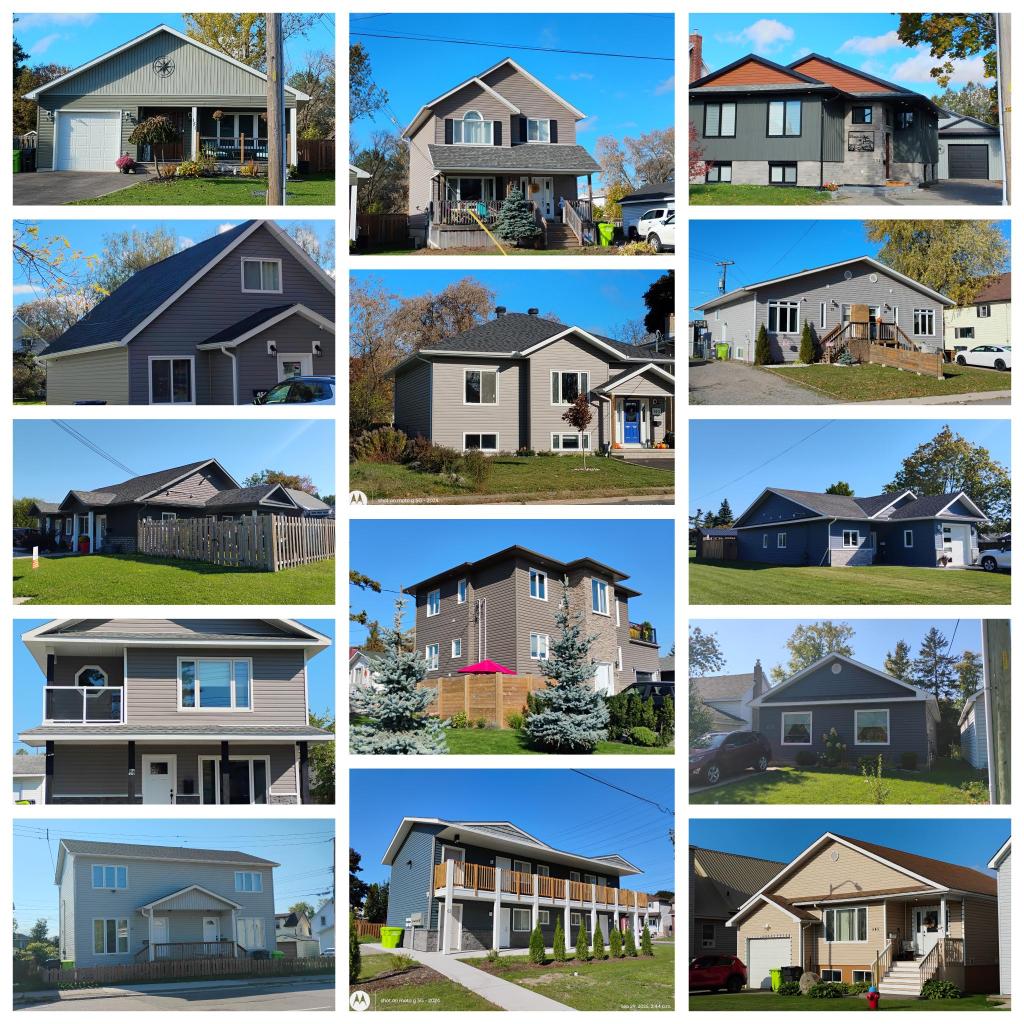
Throughout our Downtown “old neighbourhoods”, there are many wonderful new housing builds that serve as examples of what can be built in our existing “old neighbourhoods”. There are many different housing types reflecting the various needs and wants of the modern family demographic, home-ownership.
Infill housing offers advantages such as revitalizing old neighbourhoods, increasing housing supply, and promoting sustainable development by reducing sprawl and using existing infrastructure. It can also lead to economic benefits, such as job creation and increased property values, and provides residents with greater convenience through proximity to amenities and existing social circles.
Infill house building will provide the City of Sault Ste. Marie many benefits by creating these environmental, sustainable, and economic outcomes:
Reduces urban sprawl: By building on vacant or underutilized city lots, urban sprawl can be contained. It is economically important for a City to absolutely contain urban sprawl. Urban Planner and Strong Towns President Charles Marohn has long advocated that new subdivision sprawl is akin to a Ponzi scheme, cautioning cities that new subdivisions may cost more to maintain through life-cycle management than the municipal tax revenues they generate. Take, for example, the new subdivisions at the end of Queen Street East, which were absorbed into our city. These subdivisions, with 300-foot lot frontages and many empty lots, will undoubtedly cost the city more to maintain than the municipal taxes generated from the subdivision. Michigan cities like Traverse City, Midland, Harbor Springs, and Petoskey have adopted the Homeowners Association model, as their respective municipal governments will no longer provide any municipal services to new subdivisions. While these cities are not expanding their municipal service boundaries, opting instead for urban infill intensification, they make efficient use of existing land boundaries.
Leverages existing infrastructure: Infill projects can tap into established roads, water, sewer, and energy systems, which reduces the cost and impact of building new infrastructure. Any new single-family home built in a new subdivision in Sault Ste. Marie will no longer be affordable for the vast majority of families in our City. The selling price of a new single-family home starts at $700,000 and increases from there, depending on the extras; that’s why infill building represents the last chance at building affordable housing, as the infrastructure costs are already in place.
Promotes walkable communities: Infill development is often located closer to amenities, encouraging walking, biking, and the use of public transportation. Infill housing developments in existing old neighbourhoods allow families to reduce the number of vehicles that they own. Conversely, what we see in new subdivisions in the City’s periphery are multi-car garages and parking lots for driveways.
Revitalizes neighbourhoods: Infill projects can breathe new life into underused areas, leading to economic growth and an increase in local tax revenue. These new infill housing builds definitely improve their neighbourhoods; they serve as model homes of what can be built in existing “old neighbourhoods” and truly represent a creative model of affordable homes for today’s modern family.
Bring back home ownership to Downtown Housing: The troubling housing statistic contained in the 2019 Shape the Sault Housing Report reveals that 75% of housing in the Downtown core is rental housing. We need to bring home ownership back downtown; the pride of home ownership is the first step towards Downtown revitalization. Our new Official Plan discusses making our Downtown a “complete neighbourhood”; to bring back home ownership to Downtown, housing blight must be eradicated.
The 1961 “Rebuilding a City: The Urban Renewal of Greater Sault Ste. Marie: E. G. Faludi, Engineer and Planner” report states: “Some of the 4,000 middle-aged and deteriorating dwelling units are represented in almost every pre-war neighbourhood of the community. These areas are in need of major public improvement and private rehabilitation to prevent them from becoming blighted.”
Some 58 years later, the 2019 Shape the Sault Housing Report identified that 25% of housing in our City’s old neighbourhoods, as mentioned in the Faludi 1961 Housing Report, is in need of major repair or blighted.
Sault Ste. Marie’s “old neighbourhoods” truly represent an opportunity to revive the Canadian dream of owning a single-family detached home with a backyard. We need to find a way to unlock the value of our old neighbourhoods. To achieve this, we require some GIS mapping and data planning work, a strategy, and a substantial budget for urban blight removal.
A Geographic Information System (GIS) Yield Management Report needs to be completed for every Downtown and Centre-West City Block, assessing, determining, and assigning the condition of each dwelling in the neighbourhood housing blocks. Based on this report, we can determine which houses need to be demolished, which houses can be renovated to code standards, and which houses are in an acceptable present condition.
The GIS Yield Management Report will determine the projected cost per block for urban blight removal; therefore, a realistic budget for urban blight removal can be presented to City Council for approval. The GIS Yield Management Report will also determine the current housing block average housing assessments and municipal taxes, and compare them to the municipal tax yield after the blight removal strategy is carried out. The FutureSSM Housing Report reveals that the level of property assessments and municipal taxes for the “old neighbourhoods” in our City is extremely low, and a proper urban blight removal and urban redevelopment strategy must be implemented to address this issue.
To date, an urban blight removal plan or strategy is NOT included in the new updated Official Plan that the City Planning Department wants approved by City Council. This is very disappointing, as I believe that the last chance for affordable single-family homes with a backyard in our city lies with infill housing in our “old neighbourhoods”.
Mark Menean, http://www.saultblog.com
Thank you: Rebuilding a City – The Urban Renewal of Greater Sault Ste. Marie; E. G. Faludi.
Shape the Sault, Housing Report 2019.
City of Sault Ste. Marie’s Official Plan Background Report.
 Sault Blog
Leave a comment