If you travelled in Ontario this summer, you may have noticed that hotel rooms are no longer affordable. So what happened to the affordable Canadian road trip, and what has caused hotel/motel prices to become so expensive?
There was an increased demand for hotel rooms after the pandemic; a surge in domestic travel has led to higher demand for accommodations. The higher demand for domestic accommodations, as Canadians “vacation/travel at home,” caused a spike in accommodation prices that has never decreased.
Our economic tariff/trade war with the USA prompted many to reconsider vacationing or traveling at home, leading to a supply and demand imbalance within the hotel industry. A limited number of hotel rooms compared to demand, particularly in major cities, allows hotels to charge higher rates. The hotel industry also claims staffing shortages, not allowing the use of the full inventory, further constraining inventory. Hotels generally also provide amenities for guests, such as pools, saunas, concierge services, Wi-Fi internet, complimentary breakfasts, and other hotel perks that add up to a higher room rate. The Hotel Industry claims that higher interest rates, staffing costs, consumables, utilities, municipal taxes, and inflationary pricing pressures have all contributed to the recent escalation of hotel room prices.
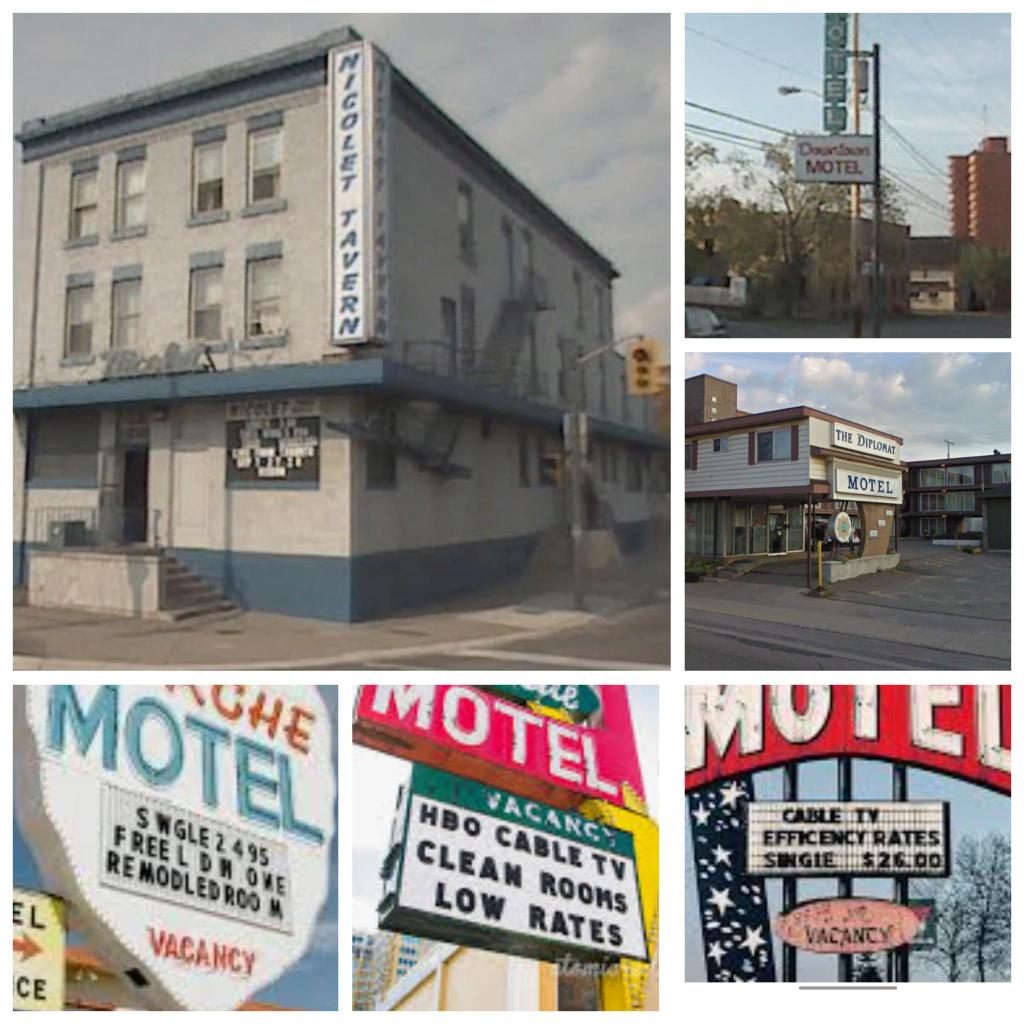
Hotels have traditionally been more expensive than the lowly utilitarian motel, but what happened to the motel’s demise? If you examine downtown Sault Ste. Marie, for example, you will notice that every motel is gone; they have either burnt down, been demolished, or converted to low-income housing. This is likely the case in every city in Ontario; motels are being pressured to convert to low-income housing or face demolition.
It’s unfortunate because motels did provide an affordable accommodation option for vacationing transients, especially those who choose to drive the “Lake Superior Circle Route”. The Lake Superior Circle Route was, at one time, a very successful tourism promotion for the Sault. This program was targeted at the American Motoring Tourist to travel all around Lake Superior. Sault Ste. Marie, Ontario, was an ideal geographic stop for vacationing motorists, and the downtown motels provided affordable and convenient accommodations.
If you travel the highways from Thunder Bay to Sudbury, many motels are closed and demolished; those that remain are in poor to terrible condition. Motels provided affordable accommodations for vacationing transients across Northern Ontario, and that segment of the market is mostly gone. In the small communities along our Northern Ontario highways, there has been absolutely no investment in the hotel/motel industry. These Northern Communities require funds to demolish end-of-life-cycle, dead asset buildings and to invest in proper, modern, affordable, and accessibility-compliant accommodations.
Hotels, motels, and other accommodations are now based on a business principle called “dynamic pricing.” In the past, when traveling, hotels and motels advertised their rack rate pricing on highway billboards and sign marquees. The price of the hotel or motel room was easily visible for all customers to see. The cost of the hotel/motel was based on a reasonable amount to charge for the service offered on a standard business model. A fair price to charge for a hotel/motel room based on their costs to deliver the product and services. The hotel industry no longer does that; hotels have adjusted their pricing models to a strategy also employed by the airlines and the concert ticket industry, known as dynamic pricing.
Hotel dynamic pricing is a strategy where room rates are automatically and frequently adjusted in real-time based on factors such as demand, occupancy, seasonality, and competitor pricing. The goal is to maximize revenue by charging higher prices when demand is high. Dynamic pricing should also reflect downward pricing with less demand; however, the industry trend is to set prices and leave rooms empty if price targets are not met.
The new online hotel booking companies facilitate this dynamic pricing. These artificial intelligence (AI) hotel booking technology companies utilize sophisticated software algorithms to monitor various data points and automatically adjust hotel room rates in real-time. Algorithms constantly analyze real-time data, including current and future occupancy rates, local and seasonal demand, competitor pricing, booking patterns, lead times, frequency of online site inquiries, and other proprietary metrics.
Based on the data, the system adjusts room rates to be competitive and profitable at any given moment. For example, a hotel or AI booking software company might increase rates for a major sporting event or convention in the city. These AI-driven hotel booking online companies use booking pressure tactics, declaring, “Rooms are in demand, only 1 or 2 rooms available, etc,” yet when attending the hotel during that period, the parking lots are often empty, and booking the room at an inflated price was just a pressure tactic. Many believe that these AI online hotel room booking companies, airlines, and online concert ticket sales companies embed cookies in our cellphones and computer systems to monitor our travel and tourism inquiries. In my opinion, hotel, airline, and concert/sporting ticket prices tend to increase with repetitive queries for the same booking event; they rarely decrease in price.
Every city in Ontario is now a tourism city. Traditionally, Ontario’s larger cities, such as Toronto, with its sporting and concert events, the CN Tower, conventions, and Ottawa, our nation’s capital, with its Parliament Hill, Museums, and Niagara Falls, were considered tourist destinations. The larger cities have always had a tourism cache; however, every city now wants to be a tourism city because of the Municipal Accommodation Tax (MAT).
This new MAT fee provides the funds necessary to transform every city into a tourism hub. Along with increasing the cost of accommodations, six (6) per cent in Sault Ste. Marie, it creates a new City Department called Tourism Economic Development Corporations (Tourism EDC), whose mandate is to stimulate tourism activity in the city, thereby driving demand for hotel accommodations, which in turn drives up hotel prices. Ironically, the city’s Tourism EDC, who want increased tourism stays, actually makes traveling and hotel prices more expensive.
The increased demand for “vacation/travel at home”, the lack of affordable accommodation options, reduced hotel supply, disinvestment in the cheap motel industry sector, additional MAT charges, junk fees, and taxes have unfortunately escalated the price of hotel rooms in Ontario.
Will accommodation prices ever decrease? Probably not. For those of us who can no longer afford these expensive hotel room rates, we can do what the Americans do: sleep overnight in a Walmart parking lot.
Mark Menean, http://www.saultblog.com
Thank you: Hotel industry Insiders, TravelPulse Canada, uniccm.com, HotelTechReport.
 Sault Blog
Leave a comment