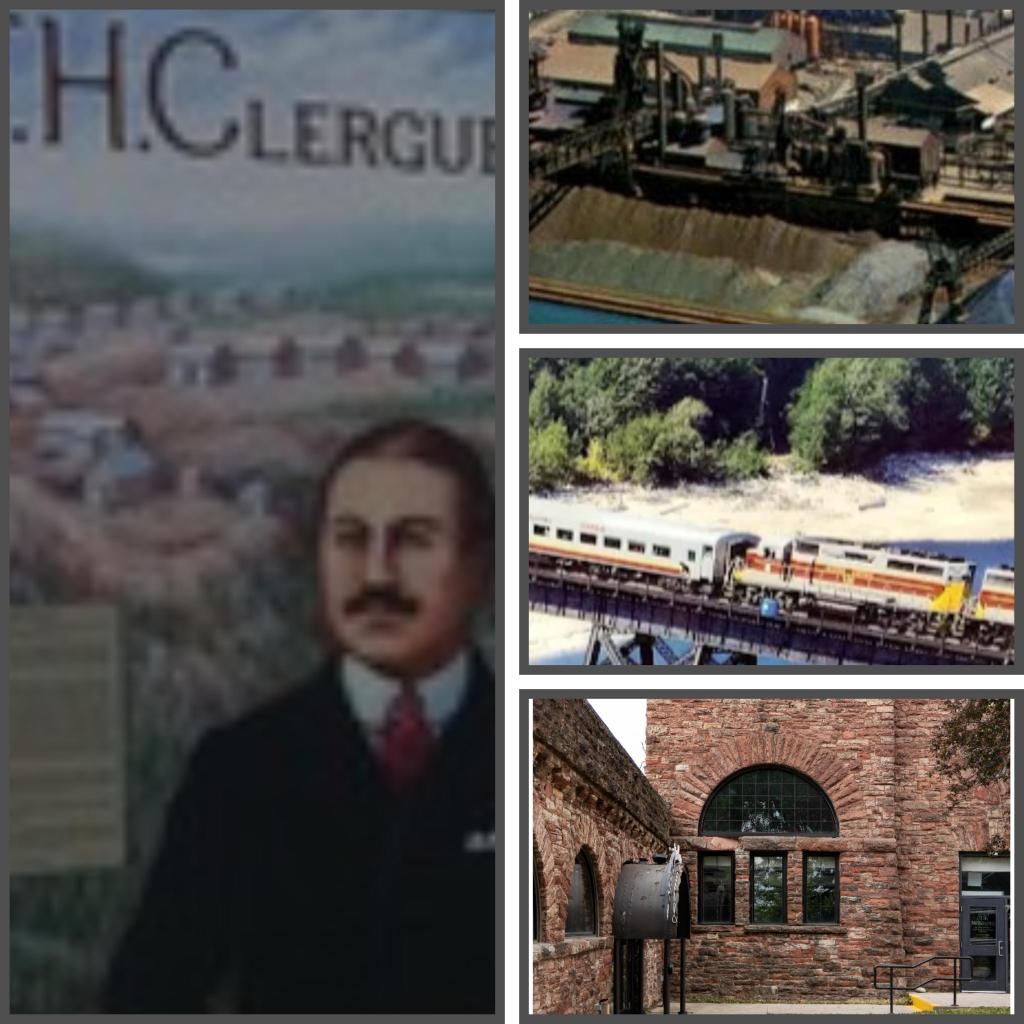
The recent loss of 1,000 jobs at Algoma Steel was another blow to a company started in the late 19th century by capitalist Mr. Francis H. Clergue.
Mr. Clergue had only been passing through the small town of Sault Ste. Marie to view another site, but saw great potential in the waters rushing down from Lake Superior. An unfinished power station was located in the area, and after a meeting with the Mayor, Clergue obtained the deed to it. The only caveat was that the town’s debt for its construction until then now fell on him, but this was no issue for the enterpriser; a meeting with financiers from Philadelphia and New York secured an investment of over $200,000.
Clergue’s first move was to lengthen the power canal, increasing its capacity to 20,000 horsepower. This caused the unique and enviable problem of having nothing to put that power toward. To solve this, Clergue then persuaded his financiers to invest in building a paper mill in the area, which would become the Sault Ste. Marie Pulp and Paper Company.
This led to a domino effect of industry. To enable the new mill to produce sulphite pulp, Clergue equipped a laboratory, oversaw the production of sulphuric acid from pyrrhotite ores, and even purchased a pair of mines in Sudbury to supply the raw materials in bulk. A boom had come to Sault Ste. Marie, due to this one man happening to pass through. The Algoma Tube Works was created, and with it came a railway that stretched from Sudbury to Manitoulin Island.
Due to over-expansion and poor financial decisions, Mr. Clergue’s business empire collapsed in 1903. Despite the collapse of his enterprise here, a surprising amount of what Mr. Clergue created lived on under new ownership. His paper mill was acquired by the Abitibi Power and Paper Company in 1928, closed in 2011, and the Algoma Central Railway, which is still in place today. Perhaps most obviously is Algoma Steel, which began as Clergue’s steel mill, is now a crucial part of the Sault.
Can the Sault expect another Mr. Clergue to happenstance our City? No, absolutely not, and nor should we want another Mr. Clergue, for all his abilities, leaving all the responsibilities of industry in the hands of a single person leads to demise. A modern culture of industry, education, and innovation must be adopted to create a long-lasting, sustainable steel industry. Perhaps the Sault could learn a lesson from its neighbouring city, Sudbury.
Sudbury, ON, is the mining capital of Ontario, if not all of Canada. There are certain supports given to the mining industry in Sudbury that Algoma Steel has not received in the Sault.
Laurentian University is the top destination for mining studies and research; the Goodman School of Mines is the entryway to Canada’s Mining University. Focused on the development of world-class credentials in all disciplines of the mining cycle, the School supports the ongoing development of future and current leaders in the mining industry and is at the forefront of conversations about mining education in the country and around the world.
The mining industry is supported by a network of economic development corporations, mining business agencies, and massive government support, culminating in the biggest mining trade show in the world: the PDAC, a global exploration/investment convention in Toronto that attracts 27,000 attendees.
The Mayor of Sudbury launched a PR campaign in March 2025 to champion plans for new mineral processing. Including a major proposed battery minerals facility by Wyloo to create Canada’s first mine to pCAM (precursor cathode active material) hub, leveraging Sudbury’s mining industry for EV battery supply.
Sudbury doesn’t need a Francis H. Clergue; they have a massive educational, research and development, industry, finance, convention, and government support system in place to expand the mining industry and related new economic development.
If you look at Algoma Steel and the steel industry in Sault Ste. Marie, it lacks the support that the mining industry in Sudbury has established.
Where are the educational programs and the steel research and development centre at Algoma University? What role does Algoma University play in the field of research and development for the product innovation of Algoma Steel products? Does Algoma University support Algoma Steel the same way Laurentian University supports the mining industry in Sudbury?
The City of Sault Ste. Marie has been with the Economic Development Corporation for the past 35 years, and the question is: What support and leadership were provided to Algoma Steel to develop new products over the past 35 years? A similar question could be asked of the Sault Ste. Marie Innovation Centre (SSMIC); What studies, reports or any work were conducted to help Algoma Steel’s product innovation?
The Federal and Provincial Governments have contributed a tremendous amount of money to save or retool Algoma Steel, with the net effect of massive job losses. Ironically, government funding to save the Steel Plant has always led to fewer products being manufactured and fewer jobs retained.
The immediate loss of 1,000 jobs at Algoma Steel, devastating for the employees, a financial disaster for the City and a government public relations fiasco, prompted the Federal Government to announce the creation of 500 new jobs, with a new steel beam mill, an idea that seems to be like pulling a rabbit out of a hat. The entire City would desperately like the idea to work; however, an educationally researched and financially sound business and feasibility study should have been done first.
There is never going to be another Francis H. Clergue showing up in the Sault; if we want Algoma Steel to succeed in the future, our City and all levels of government, EDCs, and educational institutions must provide the educational programs, research and development, product innovations, financing and networking supports to ensure the future of Algoma Steel.
Mark Menean,www.saultblog.com
Thank you: Sault Ste. Marie Museum, “Clergue” Justin Brett.
Laurentian University Website.
Northern Ontario Business: Why Sudbury can be a critical minerals processing hub to the world.

 Sault Blog
Leave a comment