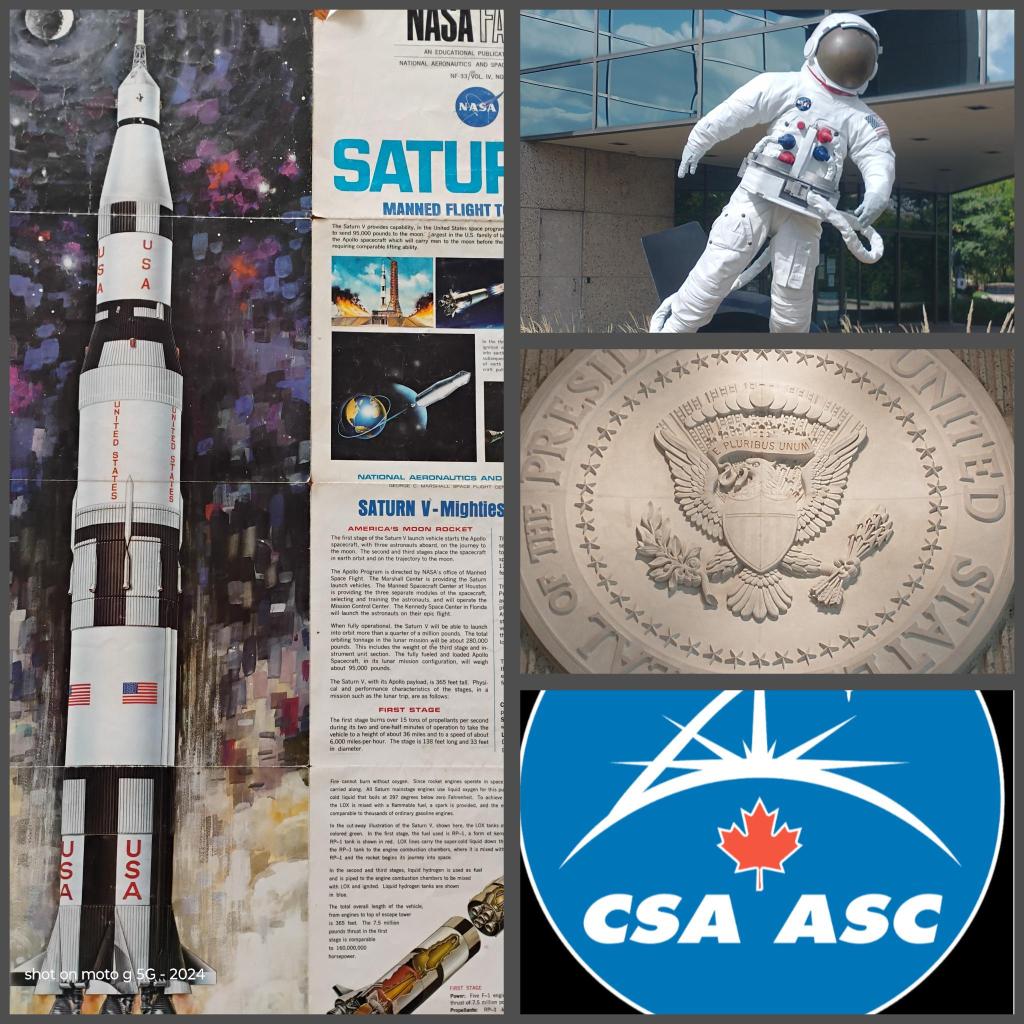
As a young boy, I was enthralled with NASA’s Apollo Space Program. The Apollo Moon Missions were an exciting time because I was swept up in the American goal of putting a man on the moon and returning him safely before the end of the 1960’s. I read and reread my Saturn V poster, outlining all the facts about the Mightiest Space Vehicle ever, and I was glued to the television.
I didn’t care how expensive and wasteful the Apollo Space Program was in achieving it’s goal. I was oblivious that American inner cities were being burnt to the ground because of economic inequality and systemic racism, or that a bloody war was raging in the jungles of Vietnam. I left that to my father, who was skeptical of the endeavour, cautioning me not to believe everything I saw on television.
Again, I didn’t care because we were going to beat the bad guys to the moon, and that was that. The goal of putting a man on the moon was achieved in July of 1969 with the descent of Astronaut Neil Armstrong onto the surface of the moon: Mission accomplished, the good guys won!
NASA won the space race for many reasons. The political will was there to get the job done by allowing NASA an open chequebook for any and all program expenditures. No short-cuts, there were in fact three major program milestones that needed completion:
The Mercury Program created the first rockets for sub-orbital flights, featuring 26 launches, 20 uncrewed, and 6 crewed from 1961-1963, with the last four flights being orbital. The Mercury Program was designed to put man into Earth orbit, test human capabilities in space, develop essential spaceflight technologies, and return him safely to Earth.
Project Gemini, the second rocket program, had four main goals: to test astronauts’ ability to fly long-duration missions; to understand how spacecraft could rendezvous and dock in orbit around Earth and the Moon; to perfect re-entry and landing methods; and to further understand the effects of longer space flights on astronauts. Project Gemini had 12 missions: 2 uncrewed and 10 crewed, from 1964-1966.
The Apollo program, with the Saturn V rocket purpose-built for going to the moon, had 13 launches, 9 crewed missions, 6 crewed moon landings, and one crewed mission that ended in a successful failure.
Of all the crewed flights on the Mercury, Gemini, and Apollo rockets, there was never a catastrophic event because of the NASA work culture that “failure is not an option.” Rocket engines and systems were tested and retested past the point of failure and over-built to exceed program requirements. There were many rocket launches in short succession, building the necessary technical skills to accomplish the moon landing.
Fast forward to 2026, and NASA is in the midst of going back to the moon. Nobody knows why, except that China wants to get there by 2030, possibly making this the second space race.
In order to return to the moon, NASA has created the Artemis Program, which will see three (3) Space Launch System (SLS) Rockets launched. One uncrewed Artemis I mission was completed on November 16, 2022; the second crewed launch with a Canadian Astronaut to circle the moon was recently postponed, and the Artemis III moonshot was moved to 2028. In the 1960’s, it took NASA forty-two (42) rocket launches, eighteen (18) being crewed, prior to the moon landing. How can NASA now believe it can safely get to the moon on three (3) rocket launches?
February’s Artemis II launch was postponed and returned to the Vehicle Assembly Building (the big rocket garage) because of a helium flow blockage in the upper stage unit, and before that, hydrogen leaks in the service mast.
Unlike the Saturn V rocket of the Apollo Program, which was purposely built to go to the moon with five F-1 rocket engines, the Command Module, Service Module, and Lunar Module; the Artemis SLS rocket appears to be a garage-built project using leftover parts, with some calling it the Frankenstein Rocket.
The Artemis SLS program relies heavily on components from the Space Shuttle and Constellation/Delta IV rocket programs to reduce costs and development time. The smaller RS-25 rocket engines (16 original Space Shuttle engines refurbished), modified Space Shuttle Solid Rocket Boosters, Interim Cryogenic Propulsion Stage from Constellation/Delta IV rockets, Orbital Manoeuvring Systems also from the Space Shuttle, and other major components from the European Space Agency are components used on the Artemis SLS rocket.
Thankfully, in February 2026, NASA announced a major overhaul of the Artemis program. Launches of the Artemis SLS rocket would be accelerated to prevent “muscle memory” issues caused by long gaps between launches. Citing a three-year interval that leads to skill atrophy, the agency is shifting to a higher-cadence standardized SLS rocket strategy, aiming for yearly launches to ensure safety.
The Apollo Program from the 1960’s was very expensive, but the benefits from the program included many technology advancements like accelerating the development of integrated circuits for computers and cell phones, satellites that provide global positioning systems, freeze-dried food, hand-held tools, moon rocks, fly-by-wire technologies, more careers in STEM-related fields, and many other advancements.
However, the only area of no advancements being made is in space travel. Space travel is still a very dangerous proposition. The amount and type of fuel energy used are extremely dangerous; the Artemis SLS uses supercooled liquid hydrogen (fuel) and liquid oxygen (oxidizer), producing highly efficient thrust, which is notoriously difficult to handle due to the extreme cold temperatures and requires specialized, often problematic seals to prevent leaks. Also, the same extremely dangerous re-entry challenge into Earth’s atmosphere still persists, with the char loss and cavity formation on the Artemis I Orion Spacecraft capsule, raising heat-shield concerns for the next crewed Artemis II mission with a Canadian Astronaut on board.
Even though the Artemis SLS rocket tries to use parts and technologies from other rocket programs, it is still very expensive. 97% of the Artemis SLS rocket is discarded adding to the 54,000 non-functioning man-made objects (space junk) larger than 10cm, and the 140 million objects smaller than 1 cm in Earth’s orbit.
Going back to the moon is extremely wasteful, expensive, and dangerous. We have been there; done that. Canada could spend its money on addressing problems here at home rather than funding America’s race back to the moon.
Mark Menean, http://www.saultblog.com
Thank you, nasa.gov.news
 Sault Blog
Leave a comment