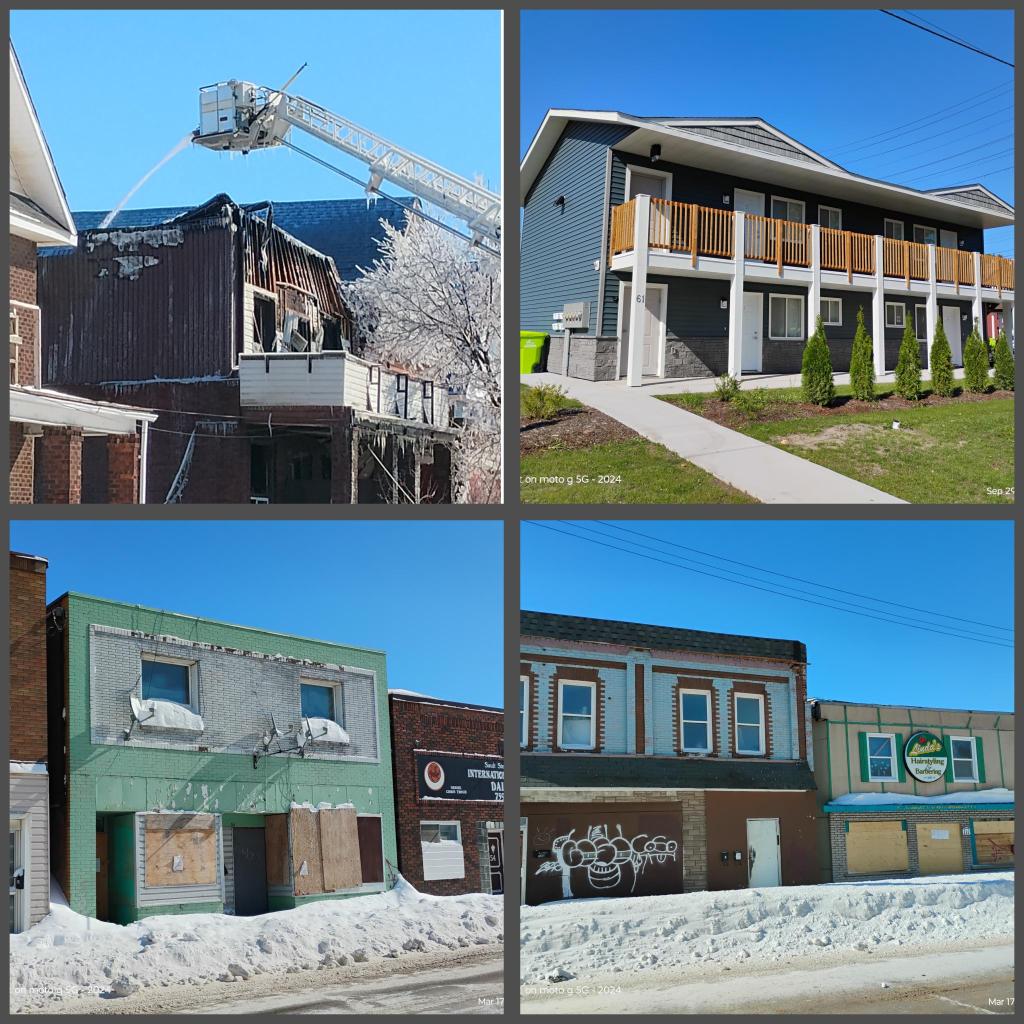
The recent fire at a Downtown Albert Street West location proved to be very stubborn to put out. I learned from an on-scene firefighter that water from the fire truck’s extension ladder was still being poured into the building 24 hours after the fire started because the tar-flat roof had collapsed and proved difficult to extinguish.
These hundred-year-old dead asset buildings usually prove to be death traps. When I inquired if there were casualties, “everyone is accounted for, including pets; however, it’s too dangerous to go into the building,” answered the firefighter.
Why are these downtown dead asset houses and buildings so dangerous? The vast majority of these buildings were constructed before the 1930s Financial Depression, making them very old. The general construction was stick-built, with lumber, small rooms on small, undersized floor joists, narrow, steep staircases, flat tar or shingle multi-layer roofs, brick-clad veneer, and lath-and-plaster walls. There is also an astonishing amount of lead, asbestos, and other toxic substances commonly used in that building material at the time.
Downtown city lots are narrow, ranging from 27 to 40 feet, resulting in buildings packed close together. Large single-family houses and buildings were subdivided into small apartments, with kitchens installed throughout the structures, illegally. These houses and buildings were never originally designed as multi-unit buildings; there are not enough proper egresses, there are no fire suppression systems – they are death traps.
However, the most dangerous aspect of these dead asset houses and buildings is neglect. According to the 2018 FuturesSSM Housing Report issued by our City Planning Department, 75 percent of centre, centre/west Downtown housing is rental, and 25 percent of the housing in these neighbourhoods is in need of major renovations or demolition.
The higher the percentage of rentals in a neighbourhood, the higher the blight rate. When asked why the fire started, there is no real answer other than neglect. These dead asset houses and buildings needed to be brought up to code standards for electrical, egress, and fire suppression systems. The landlord is responsible for providing a safe place for the tenant to live. The question then becomes, why is this not done, and why is it not enforced?
The acceptance of a “culture of blight”. Collectively, everyone turned a blind eye to the centre, centre/west housing blight; as it increasingly became rental as homeowners fled to the suburbs, the landlord increasingly became a slumlord, and rentals and investments were neglected because it did not make financial sense. The majority of the blame must lie with the property owner, who is responsible for maintaining the house or building in accordance with municipal property standards.
City Councillor apathy and neglect. Since 2005, I have pitched an urban blight removal idea to many councillors with the same answer: “the City of Sault Ste. Marie is not in the demolition business; that is a private sector matter, and I will not ask the taxpayer to fund the expropriation and demolition of dead assets houses and buildings in the Sault.”
The Sault lacked urban renewal funding from the Provincial and Federal Governments. Unlike Michigan’s Troubled Asset Removal Program (TARP) 2008-2023, which provided direct funds to Michigan municipalities like Detroit, Bay, Flint, Saginaw, and Midland, which used the funds for the expropriation and demolition of dead asset houses and buildings. The Sault desperately needed a similar program, as we have more in common with Michigan’s Rust Belt cities than with our Southern Ontario counterparts. Ironically, rather than help our city, the Provincial Government dumped the financial responsibility of demolishing the Old Hospital Site on the taxpayers of Sault Ste. Marie.
Can the City Building and Bylaw Enforcement Department be blamed for neglecting these blighted properties? For decades, the Building and Bylaw Enforcement Department was grossly underfunded, leading to a reactive approach to property-standard enforcement. Property standards are only enforced when neighbours complain, and the mechanisms and financial enforcement tools for property standards compliance were lacking for decades (recently improved). However, the City Building Department went from being a resource centre to a revenue centre and currently has over $2 million in accumulated building permit fees, so money is no longer an issue; the question is: with this newfound departmental wealth, will bylaw enforcement become proactive, rather than reactive?
Our City Planning Department must include a properly funded urban blight removal program in the new Official Plan. We, as citizens, have to be prepared to spend money on removing dead asset houses and buildings; as a business investment for our City, removing these dead assets is the right thing to do because they are extremely unsafe and stymie the ability to attract investment dollars into the old neighbourhoods for urban renewal. This would signify a policy shift where the Corporation of the City of Sault Ste. Marie would be prepared to actively acquire and demolish dead asset houses and buildings as they return to market and, expropriate unsafe dead asset houses and buildings as seen fit.
For example, the two worst blighted areas in our City are the Wellington Street and Albert Street corridors. There are a number of buildings between Gore Street and Steelton that are absolute fire death traps; very old, boarded-up main-floor former retail buildings with second-floor substandard apartments. These buildings represent the worst case where the main-floor areas are magnets for crime, drug-dealing, and arsonists, with the second-floor housing the most vulnerable tenants in unsafe apartments.
These dead asset houses and buildings are at the end of their useful life; removing them allows new housing projects like the four-plex at the corner of Wellington and Abbot and the duplex on Wellington and Gloucester to replace them. These homes represent the future of Downtown housing, a safe home that kick-starts reinvestment in our Downtown housing neighbourhoods.
Fire should not be the Sault’s only urban renewal plan. An urban blight removal plan and strategy, entrenched in the new Official Plan and supported by aggressive bylaw enforcement, fully funded by all three levels of government, will create the leadership required in our City to rid our Downtown neighbourhoods of these fire-prone, dangerous, dead-asset houses and buildings.
Mark Menean, http://www.saultblog.com

 Sault Blog
Leave a comment