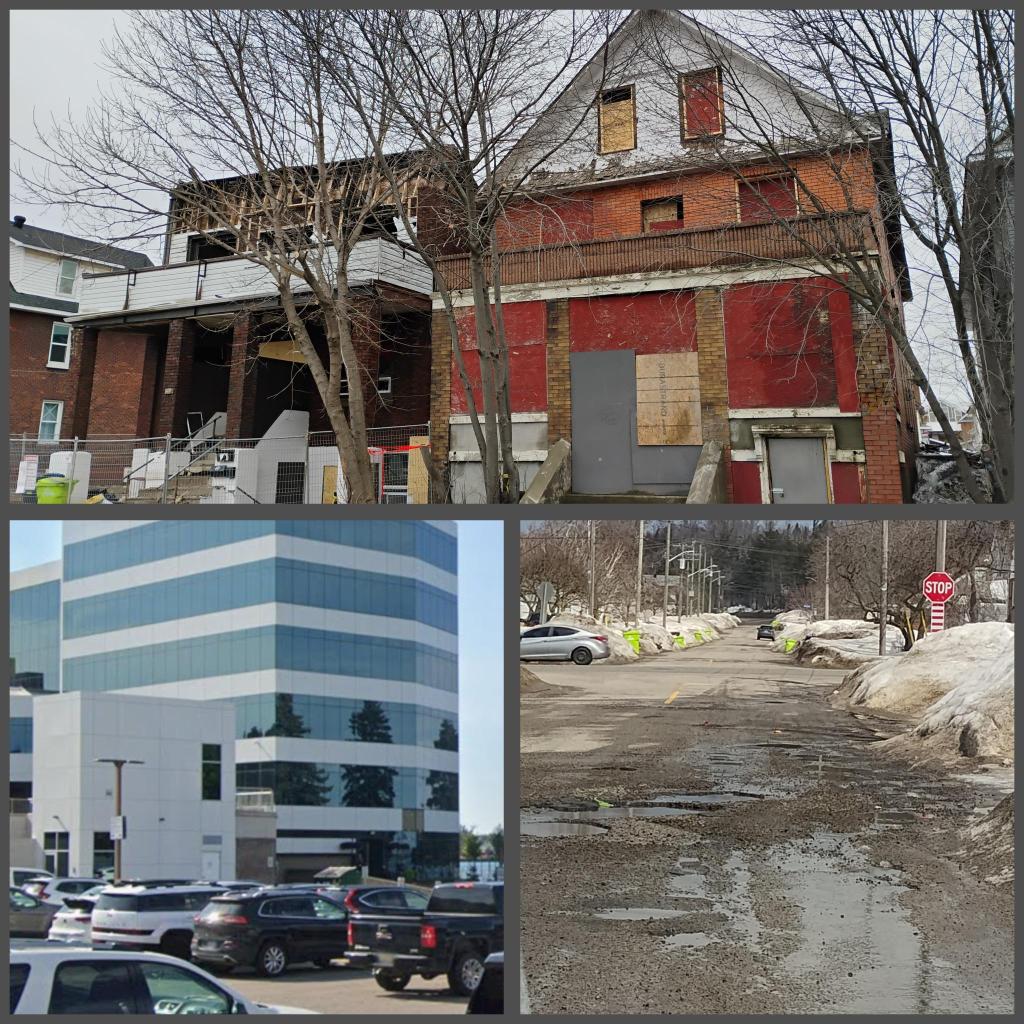
This month heralded a change in leadership at Sault’s Building and Bylaw Enforcement Department, and, along with accumulated millions of dollars in building permit revenue, we ask: Will the Sault finally rid itself of the culture of housing blight that has plagued our City?
Recently, the City Council passed a resolution asking staff to report back on the potential to create a targeted proactive property standards, yard maintenance, and vacant home bylaw blitz. Again, we ask: What is this going to accomplish that the Sault Building and Bylaw Enforcement Department hasn’t been trying to do for the past decades?
The inherent decades-long problem of housing blight is not singularly the Building and Bylaw Enforcement Department’s lack of results, but an understanding that there is the absence of a real plan, strategy, and serious financial budget in our Official Plan on how to deal with housing blight and property standard compliance for the last number of decades.
If we compare cities like Detroit, Bay, Saginaw, Flint, and Midland, Michigan, that experienced significant declines in industry jobs and population, similar to the Sault, which precipitated the decline of numerous neighbourhoods; these Cities had considerable financial help in solving their housing blight problem.
After the 2008 Housing Crisis, the United States Federal and Michigan State governments provided funds directly to these Michigan Cities to help eradicate housing and dead asset building blight. The Temporary Asset Relief Program and the Revitalization and Place-making program are financial tools used in Michigan municipal official plans to eradicate blight and rebuild communities and neighbourhoods.
Ontario did not produce a similar program because, for the last 26 years, Southern Ontario housing development boomed, and Northern Ontario’s housing blight was not a priority. Case in point is the saga of Sault’s Old Hospitals; had the Sault obtained site demolition and rehabilitation funds, we could have avoided the complete fiasco these Old Hospitals befell our City.
A proactive Official Plan policy will require an expropriation and demolition fund, which will allow the City Building and Bylaw Enforcement to go block by block in the old neighbourhoods and remove the worst dead asset buildings and blighted, boarded-up houses. Remember, we are not just eradicating blighted buildings and houses, but ridding ourselves of the slumlords and the failed Southern Ontario Housing Corporations that hide under the onerous laws that render our Building and Bylaw Enforcement impotent.
Removing dead asset buildings and blighted, boarded-up houses will free up existing valuable infrastructure and place-making for new affordable downtown housing solutions. Without a properly funded housing blight removal plan and strategy in the updated Official Plan, we are just going in circles with reactionary City Building and Bylaw Enforcement.
Unfortunately, the same can be said of the terrible condition of our City’s streets and roads, with extensive decades-long potholes, amounting to what I am labelling as an acceptance of pothole blight.
Because of shared neglect by all those responsible for maintaining a “core city function,” our streets, roads, and especially arterial corridors are in terrible condition. City Council finally passed a resolution to develop a data-driven digital tool that supports road rehabilitation and preventive maintenance and improves service levels for residents. This is a very good digital tool, instituted by other Cities decades ago, that maps pothole information in a geographic information system and posts it on a city’s website to show where the pothole damage and severity are.
In our Official Plan Background Report, Schedule D: Mobility and Major Infrastructure GIS map is identified; however, it does not identify the condition of pothole blight on streets and roads, which is a “core city function”. Without this information entrenched in the City’s Official Plan, the City Council cannot allocate the necessary funds needed to address the pothole problem on roads and streets.
Like our City’s blighted houses, the pothole problem was kicked down the road for decades; the only proactive solution is an Official Plan policy committing to extensive road and street resurfacing, which will be extremely expensive but necessary.
Mark Menean, http://www.saultblog.com


Leave a Reply