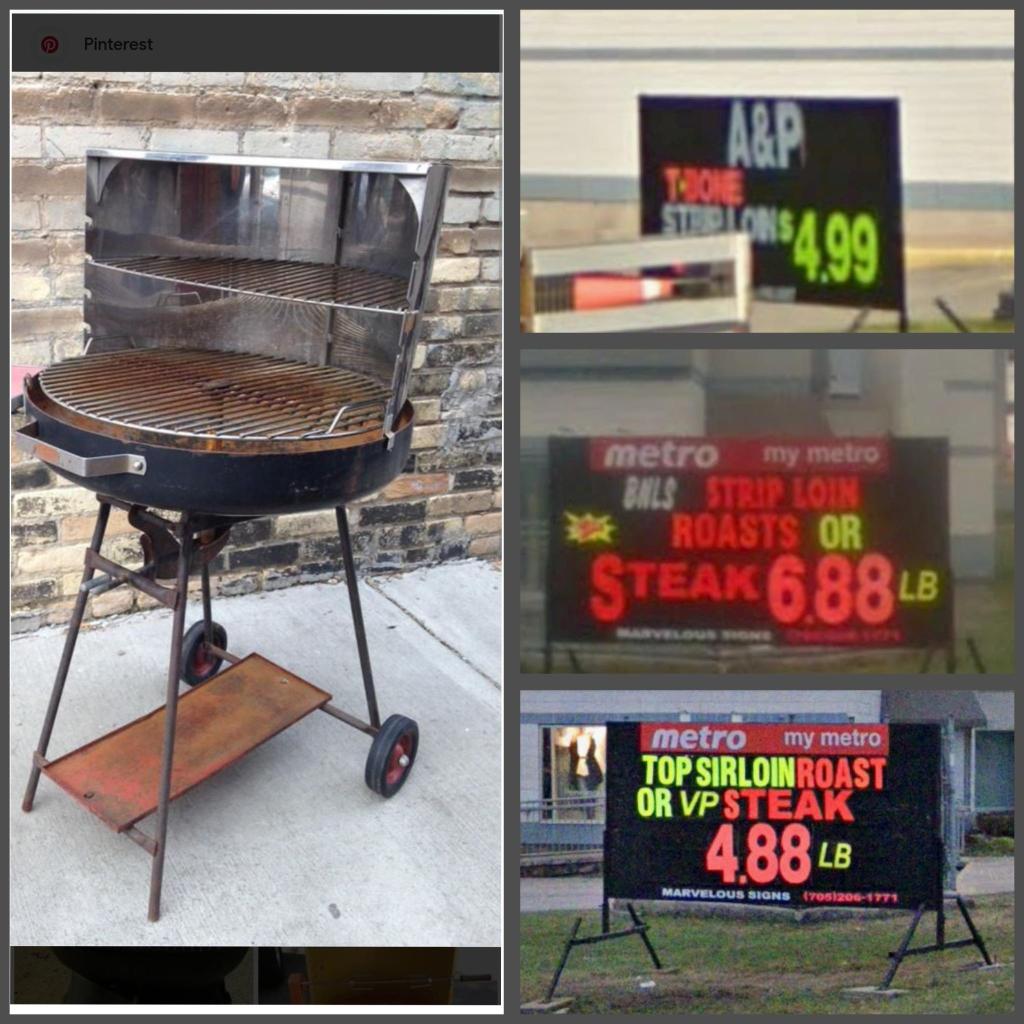
Some would say the greatest signs of summer in the Sault are the melted snowbanks, flowering tulips, or trees blossoming, which I agree with wholeheartedly. However, the greatest summer sign, in my opinion, was the $4.99 steak sale sign by our National Grocers on Great Northern Road, 2nd Line, or Trunk Road.
I am of the belief that every Canadian should have the inherent right to a big Canadian beef-steak BBQ every Saturday afternoon/evening in their backyard, enjoying a Canadian beer to make up for that extremely long, tiring, punishing winter.
Beef was our national protein; as a boy, it was my Saturday afternoon job to get the Kingsford Charcoal Briquets ready with excessive doses of fire starter fluid on the round BBQ, spinning-grate model, for the greatest-tasting Canadian beef BBQ. Spoiled, I got my own steak, and barbecued it Chicago-medium, charred on the outside and a little pink in the middle. An absolutely fantastic memory, because my hard-working, frugal parents went to the butcher, purchased beef quarters on sale, and stored them in the massive downstairs freezer.
Canada is known for producing very high-quality beef, from grassland regions where cattle can graze freely and where standards for animal welfare and food safety are very strict. For decades, the price of Canadian Beef was economical; maybe even too low; the Sault enjoyed low prices for quality Canadian beef steak cuts with summer price specials ranging from $4.99 to $6.99 per pound before the COVID-19 Pandemic. These prices are long gone; strip-loin steak prices are currently at $14 plus per pound; so what happened to affordable beef in Canada?
The outbreaks of COVID-19 at Canada’s two largest meat-packing plants caused a backlog of roughly 100,000 cattle, all stuck on farms and costing ranchers hundreds of millions in extra feed and lost revenue, which seemed to set off the spiraling of beef costs.
This backlog has also renewed concerns about the lack of diversification in Canadian beef processing, due to North American supply chains. Cargill’s plant in High River and JBS’s plant in Brooks, AB, represent 70 percent of all federally inspected beef processed in Canada. Add in Cargill’s plant in Guelph, Ont., and the three account for 85 percent, so there are major consequences for even a brief pause in production.
Canada’s cattle and calf inventories are at their lowest level since the 1980s. Driven by severe multiyear droughts on the Prairies and escalating operational costs, ranchers were forced to liquidate herds. Stocks are stabilizing; however, the long rebuilding phase means beef prices will remain high.
The Canadian beef processing industry has hyper-globalized; the process was a foreign multinational’s takeover of a Canadian industry. Every industry in Canada now suffers the consequences of hyper-globalization.
These Global Corporations control the Canadian beef industry – Canada exports beef, and we also import it from other countries like Australia and Mexico. When demand is high elsewhere or when other countries face their own production issues, it can disrupt the entire supply chain. I have always wondered why Canada needed to import Mexican beef that cannot be barbecued, as it is as tough as shoe leather. In my opinion, because of hyper-globalization, our high-quality beef is exported while we are forced to purchase inferior-quality Mexican beef.
Canada has hundreds of provincially inspected processors, but they only process around four percent of the Canadian herd, approximately 4,000 cattle per week, which is slightly less than what Cargill’s plant in High River can do in a day. Federally inspected facilities are the only ones able to ship between provinces and export internationally.
The Algoma district has local beef processors; however, in industry terms, it’s all about production volume, “it pounds per man hour” of production. Smaller processors cannot handle the volume of the large multinationals; this means that if you want quality local Canadian beef, it will cost more.
I do not consume as much beef as I did before; however, I still very much enjoy the great tradition of a summer backyard barbecue with a quality Canadian beef steak: paying more for local Canadian beef is definitely better than accepting inferior global beef.
Mark Menean, http://www.saultblog.com


Leave a Reply