I had the opportunity to spend some time in Lower Manhattan, in the Wall, Pearl, Gold, and Fulton Street area near The Battery, and witnessed firsthand what downtown urban congestion really is. Unlike Midtown and Uptown Manhattan, which are built on a structured grid pattern, Lower Manhattan’s Streets evolved over centuries of Dutch and British colonial settlement. This created a haphazard, narrow street design with unnatural bottlenecks, unpredictable turns, and tight corners. These streets are filled with commercial businesses and residential apartments that require a tremendous amount of goods to be delivered; these commercial delivery fleet vehicles congest the already limited street space. Pile in the thousands of Ubers and Taxi Cabs into the most dense city in North America, and that is real urban congestion. It is a built-up, dense vertical environment at the tip of an island, and everyone understands: it is what it is; there is no changing the streets.
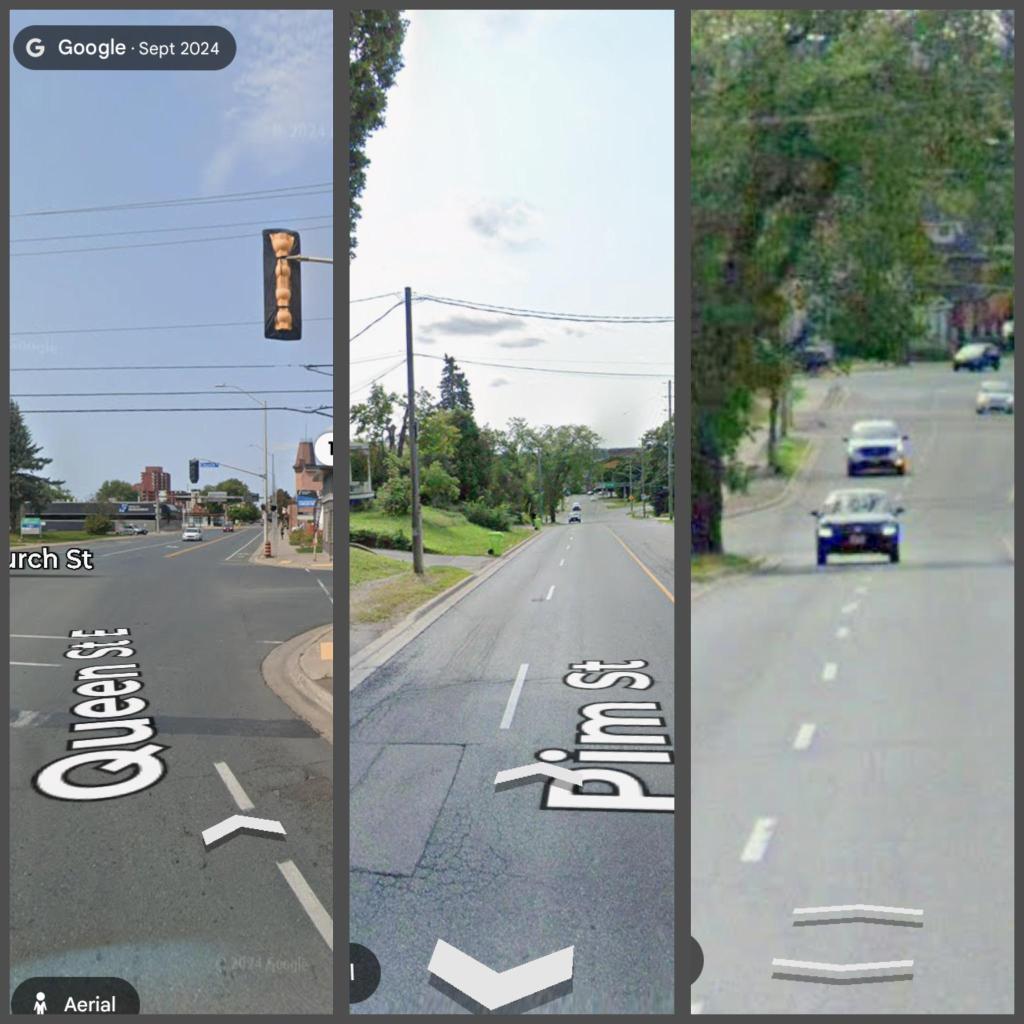
The City of Sault Ste. Marie is trying to tell us that we require another consultant’s report on the redesign of Pim, Church, Wellington, and Queen Streets and their intersections. A similar problem is that the streets were built before the advent of the automobile and are too narrow, with sub-optimal intersections, creating vehicular and pedestrian safety issues.
If Pim Street requires an infrastructure upgrade to either the sanitary sewer or the storm drains, it is understandable that it has to be done; however, I cannot understand the need to expropriate housing to widen Pim Street.
I really wonder what traffic counts were completed to justify the widening of Pim Street. The fact that Pim Street is tight in this area actually serves as a calming measure, so that vehicles do not speed up the incline as they do on the inclines of McNabb Street or Second Line Road. This is called “charging the hill,” where vehicle drivers charge the hill and then race others up to the top.
The reality is that there is NO traffic congestion in this area; it is on Great Northern Road, north of Northern Avenue, past Second Line Road, through the new big-box intersections. There is absolutely no need to widen any of these other streets in the Wellington, Pim, Queen, and Church area, as the Sault’s new downtown is actually now uptown. By moving the Hospital and the retail and commercial businesses to Great Northern Road, calling into question whether two lanes are actually needed on Church Street to the Pim Street merge. The traffic volumes are no longer there; widening Church to Pim is a waste of money.
Is there really a need for a sidewalk on the west side of Pim Street? Putting in a sidewalk requires expropriating housing. Since there is a sidewalk on the other side of Pim Street, the need for another is questionable and would result in a very expensive sidewalk without a pedestrian count.
There is no congestion on any of the aforementioned streets; traffic flows freely; there are very few delivery vehicles; and there is access via a back lane between Church and Pim Streets that serves as a convenient delivery corridor.
A City Councilor mentioned that the one-way streets are dangerous and that she observed many instances of motorists driving the wrong way on them. There are many pros and cons of one-way versus two-way streets; however, in my experience, two-way streets are better suited to city grid patterns than to convoluted “old neighbourhood” street infrastructure. However, after spending hundreds of thousands of tax-paying dollars, the consultant’s report will tell the City Council that changing these one-way streets to two-way streets will create more problems than it solves.
I will admit that since the traffic lights were removed at the Queen and Church Street intersection, it has become dangerous for pedestrians and cyclists. The primary problem is the concept of enforcing the speed limit on Queen Street; for many, the 50 km speed limit is just a suggestion, and it really doesn’t apply to the driving scofflaw.
Drivers speed down the entire length of Queen Street daily, aggressively tailgating and charging into the Church Street intersection at high speed, cutting the corner, and making it difficult for pedestrians to clear the intersection because it is too big. It takes too long for pedestrians to cross Queen Street to gauge speeding drivers from Queen Street East. Vehicle speeds from Queen Street East must be reduced through vehicle-calming measures, which may include road bollards, a speed bump, or the reinstatement of the traffic lights.
Most cities have some difficult street infrastructure areas; the Sault has the Church, Pim, Queen, and Wellington intersections, which are not ideal but are not as bad as in other Cities. After all the consultant studies are done, I’m sure we will discover that the perceived problems with this area’s street infrastructure are more about driver awareness and behavior than about infrastructure deficiencies.
City Councillors and City Administrators are tone-deaf; they refuse to hear the loud complaints from taxpaying citizens who want action on the extensive, pothole-blighted existing street infrastructure. There is a constant need for repeated consultant reports and unnecessary projects rather than addressing core City functions. Resurface the existing pothole-blighted streets and leave the Queen, Church, Pim, and Wellington Streets alone, because it is what it is.
Mark Menean,www.saultblog.com


Leave a Reply